
Your shoes are the only piece of equipment you use roughly 8,000 to 10,000 times a day. Every step presses a little more of your movement pattern into the foam and rubber.
That makes them one of the most honest pieces of evidence you own. A physiotherapist, a chiropractor and I would all look at a worn shoe and see the same thing: a record of how that person has been loading their body, for months.
Grab the shoes you wear most. This takes about two minutes.
The width test
Stand up, with your weight fully on your feet. Look straight down at your shoe.
Your foot widens when you stand on it — and widens more when you walk. If the shoe looks the same width as your foot, or narrower, it's squeezing your forefoot with every step.
What you want: the shoe should look very slightly wider than your foot at its widest point.
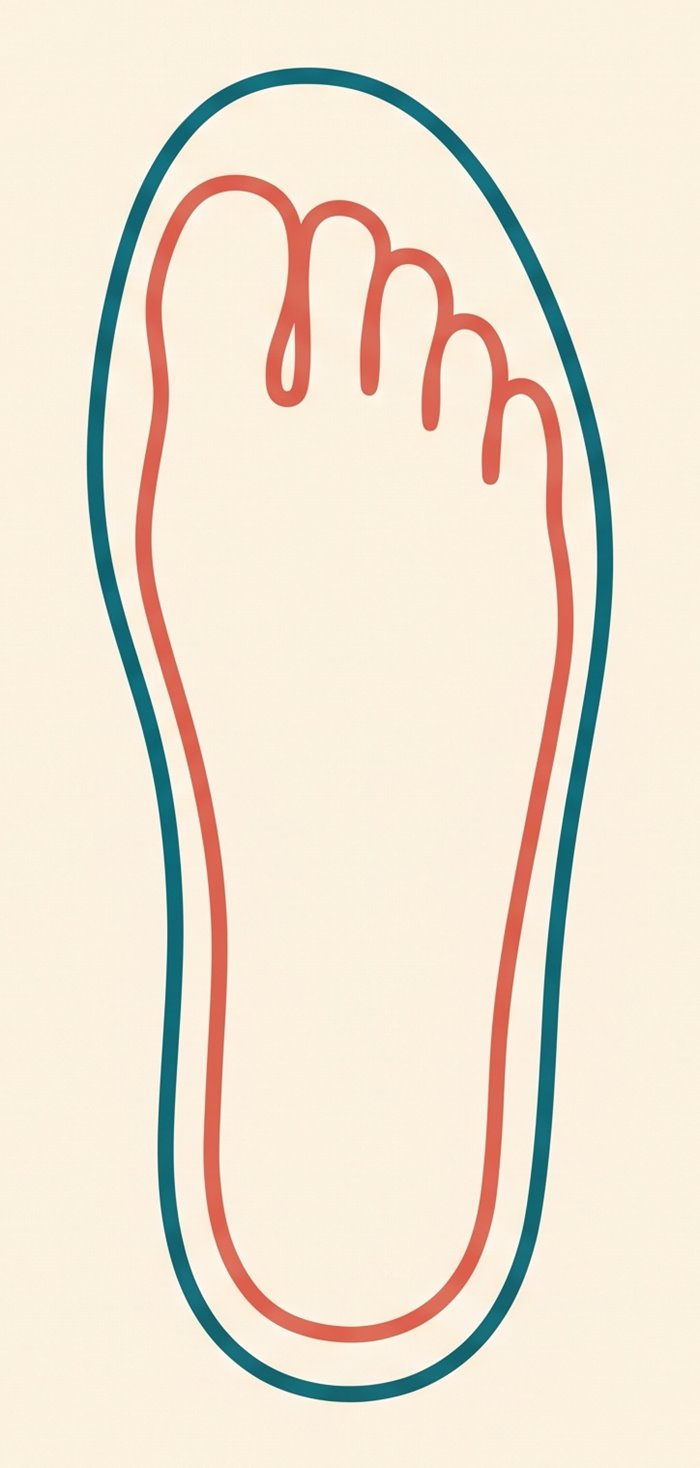
Years of a too-narrow toe box is one of the ordinary, boring contributors to bunions and to irritated nerves between the toes. Not the only cause — but a daily one.
The heel hold test
Put the shoes on and lace them the way you normally do. Now try to slide a finger down behind your heel, between your heel and the back of the shoe.
Pass: your finger doesn't really fit. The heel is held.
Fail: your finger slides in easily.
If your heel is loose, it moves inside the shoe on every step. The heel has a built-in fat pad designed to absorb impact — but it only works when the heel is actually seated. A sloppy heel means your foot spends all day doing extra work just to stay stable.
Often this is a lacing problem, not a shoe problem. Try properly tightening them before you replace them.
The twist test
Take the shoe off. Hold the heel in one hand and the toe in the other, and gently twist them in opposite directions, like wringing a towel. Then try to fold the shoe in half, toe to heel.
A shoe with life left in it resists you, and springs back.
A dead shoe twists easily, folds in half, and stays bent.
Shoes don't usually fail visibly. The upper still looks fine while the midsole underneath has quietly stopped doing its job. This is the fastest way to catch that.
The pair test — the one that surprises people
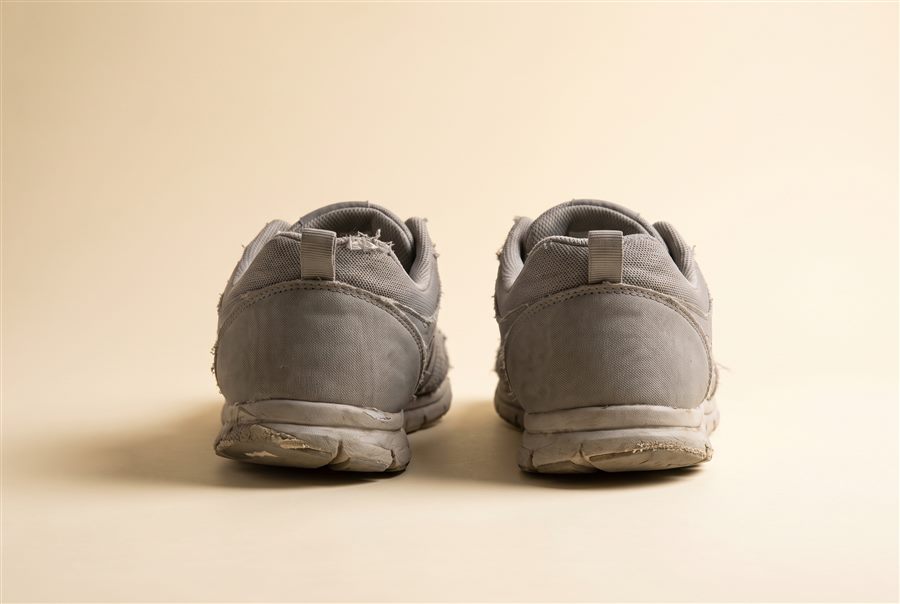
Put both shoes on a flat table. Crouch down so they're at eye level, and look at them from behind.
Ask:
- Do both heels sit straight up, or does one tilt inward or outward?
- Is one more worn down on the outside edge?
- Do the two toe boxes look like the same shape?
Here's the part people don't expect: this is worth checking on brand-new shoes too. Quality control in footwear is genuinely inconsistent, and a left and right can come out of the same box noticeably different.
If your two shoes aren't the same, your two legs aren't getting the same deal — about ten thousand times a day.
The wear map
Flip both shoes over and compare the soles side by side. You're not looking for wear — wear is normal. You're looking for differences between left and right.
- One heel more worn down than the other
- More wear under one big toe
- One toe box scuffed at the very front
- Deeper creasing across the top of one shoe
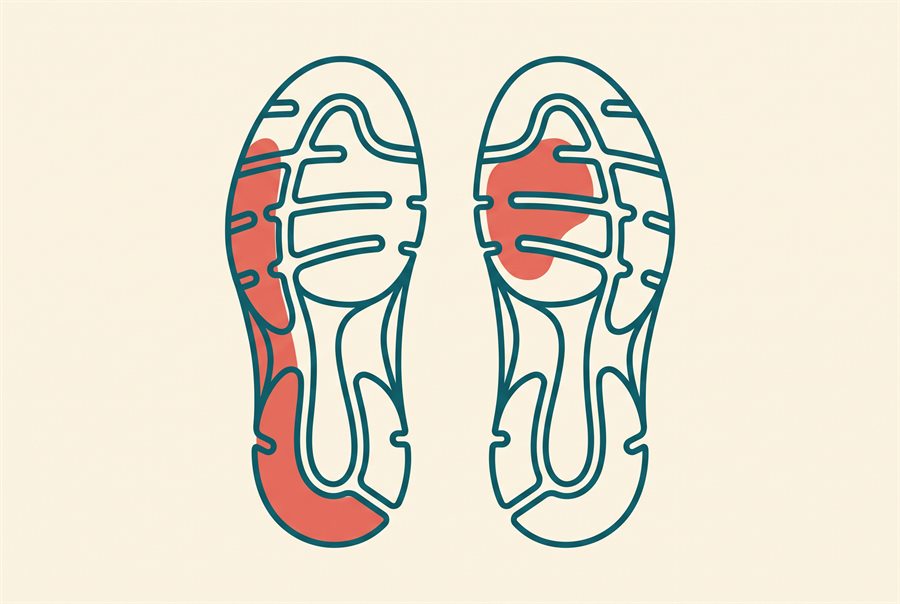
Then look inside the shoes, at the insoles. Friction marks show up there first, and they're often more uneven than the soles.
Now here's the part that matters most.
Most people find uneven wear and buy new shoes. That feels like solving it. It isn't.
The shoes didn't create the pattern — they recorded it. New shoes wipe the evidence without changing what caused it. Give it a few months and the same pattern comes back, in the same places, because the thing driving it was never addressed.
Uneven wear means something further up the chain — a foot, an ankle, a hip, an old injury you've stopped thinking about — is making one side work differently than the other.
What to do with what you found
If everything passed: good. Re-check every few months, and replace shoes at roughly six months of regular use, or 300–500 miles of running.
If you failed the width, heel or twist tests: that's usually a shoe problem, and a new, properly fitted pair genuinely helps.
If you failed the pair test or found uneven wear: that's not a shoe problem. That's your body's movement pattern showing up in rubber, and buying new shoes will not change it.
See checks 3, 4 & 5 — free
Check 4 is the one that surprises almost everyone. Enter your email to unlock the rest, and we'll send you a copy to keep.
One honest limitation: this checklist can tell you that something is uneven. It cannot tell you why. Uneven wear under the right big toe could come from the foot, the hip, the pelvis, an old ankle sprain, or how you sit at work. Those are different problems with different fixes — and guessing wrong wastes months.
Want to know which one it is?
That's what the 90-minute head-to-toe assessment is for. We test the whole chain — foot, ankle, knee, hip, back — find what's actually driving the pattern, and build the plan to correct it. Then we re-test to prove it's working.
Bring the shoes you wear most. Genuinely — they tell me a lot before you say a word.
About the method: Nadeem Tejani is a NASM Certified Personal Trainer and Corrective Exercise Specialist in Scarborough, Ontario. His assessment approach comes from advanced clinical training in exercise therapy, refined over thousands of clinical hours - combined with his own hands-on work with clients in Scarborough.
This guide is general education, not a diagnosis or medical advice. If you have numbness, weakness, loss of bladder or bowel control, fever, unexplained weight loss, or pain following a serious injury, please see a physician first.